|
|
|
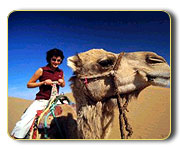
Rajasthan : Spanning through the magnificent states of Gujarat and Rajasthan the Indian Desert is an amazing place to look for truly fantastic wild flora and fauna. Animals and plants in the desert survive in a hostile environment. Intense heat, searing sun, and lack of water are just a few of the challenges facing desert animals and plants. The desert areas of India houses some animals that never drink and plant seeds that can stay alive for years without water are typical of the miracles of this most infirm zone. In the Indian subcontinent, deserts, with an area of about 225,000 sq km covers just under 7% of the total land area. |
|||
|
Divided into two distinct sub-divisions - Thar desert region covering 180,000 sq km in the state of Rajasthan and the Rann of Kutchh, covering some 45,000 sq km of western Gujarat are lands of grand mirage and miracles.The desert cat, desert fox, the winter-visiting houbara bustard and several sandgrouse species,as also a few reptiles are found only in the Thar.Blackbuck, chinkara, the Indian wolf, caracal, great Indian bustard can also be seen here. States : Rajasthan and Gujarat.Major Locations : Thar Desert and the Rann of Kutch Best Time to Visit : October to March. Rajasthan The royal state of Rajasthan is a haven for a wide spectrum of wildlife. The topography of Rajasthan ranges from the desolate desert, dry and deciduous forests, rocks and ravines to wetlands and lush, green forests. And each of these areas inhabits a large variety of animal and bird life within there boundary. | ||||
|
Zone : North India.Location : To the Northwestern corner of India. Capital :
Jaipur Best Time to Visit : Most of these areas are open to visitors round the year
but are closed briefly during the monsoon. But the best time to visit is during
November to March. |
 Jaipur : -
Jaipur, popularly known as the Pink City, was founded in 1727 AD by one of
the greatest rulers of the Kachhawaha clan, the astronomer King Sawai Jai Singh.
The city is a fine blend of old and new. When you approach the city you will be
surrounded by the pink walls of the buildings around you, which were painted pink
to create an impression of red sandstone buildings of Mughal cities. Jaipur boasts
of several attractions, some of the which are - the City Palace, the Hawa Mahal
(The Wind Palace), Amer Fort, etc.
Jaipur : -
Jaipur, popularly known as the Pink City, was founded in 1727 AD by one of
the greatest rulers of the Kachhawaha clan, the astronomer King Sawai Jai Singh.
The city is a fine blend of old and new. When you approach the city you will be
surrounded by the pink walls of the buildings around you, which were painted pink
to create an impression of red sandstone buildings of Mughal cities. Jaipur boasts
of several attractions, some of the which are - the City Palace, the Hawa Mahal
(The Wind Palace), Amer Fort, etc.|
Jaisalmer :
|
 The name Jaisalmer evokes a vivid picture of sheer magic and brilliance
of the desert. Founded by Rawal Jaisal in 1156 A.D., the remote location of Jaisalmer
kept it almost untouched by outside world, even during the days of the Raj. Very few
cities can boast of the magnificence that surrounds Jaisalmer. The Major attractions
are - The Jaisalmer Fort, the Sam Sand Dunes, Camel Safari.
the monuments of Jaisalmer have withstood the buffeting winds of the desert all
through. Jaisalmer is a paragon of beautiful culture and harsh climatic conditions;
these together leave a lasting impression on the visitors. The old city was
completely encircled by a wall but much of it has crumbled sadly for want of
building material in recent years. The massive golden fort, which is the essence of
Jaisalmer, is entered through First Gate; is a burrow of narrow streets with Jain
Temples and old palaces. The main market, the Sadar Bazar is right below the hill.
The bank, offices and several shops are also located near the Amar Sagar Gate to
the west.Desert festival Significance: To display the glory of the desert land.
The name Jaisalmer evokes a vivid picture of sheer magic and brilliance
of the desert. Founded by Rawal Jaisal in 1156 A.D., the remote location of Jaisalmer
kept it almost untouched by outside world, even during the days of the Raj. Very few
cities can boast of the magnificence that surrounds Jaisalmer. The Major attractions
are - The Jaisalmer Fort, the Sam Sand Dunes, Camel Safari.
the monuments of Jaisalmer have withstood the buffeting winds of the desert all
through. Jaisalmer is a paragon of beautiful culture and harsh climatic conditions;
these together leave a lasting impression on the visitors. The old city was
completely encircled by a wall but much of it has crumbled sadly for want of
building material in recent years. The massive golden fort, which is the essence of
Jaisalmer, is entered through First Gate; is a burrow of narrow streets with Jain
Temples and old palaces. The main market, the Sadar Bazar is right below the hill.
The bank, offices and several shops are also located near the Amar Sagar Gate to
the west.Desert festival Significance: To display the glory of the desert land.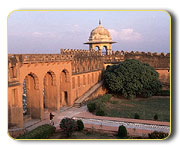 
|
Bikaner :
Lying in the north of the desert State, the city is dotted with scores of
sand dunes. Bikaner retains the medieval grandeur that permeates the city's
lifestyle. More readily called the camel country, the city is distinguished for
the best riding camels in the world and hence boasts of having one of the largest
Camel Research and Breeding farms in the world. The ship of the desert is an
inseparable part of life here. Modern Bikaner is the result of the foresight of
its most eminent ruler Maharaja Ganga Singh (1887-1943) whose reformative zeal set
the pace for Bikaner transformation from a principality to a premier princely
state. |
|
|
Jodhpur :
| ||
 This bustling desert city is the second largest in Rajasthan after Jaipur.
It was founded by Rao Jodha, the leader of the Rathore clan, in 1459 AD. The
mammoth, imposing fortress (Meherangarh) has a landscape dominating a rocky ridge
with the eight gates leading out of fortress. The new city is outside the structure.
The Rathores enjoyed good relations with the Mughals. Maharaja Jaswant Singh (1678)
supported Shah Jahan in the latter's war of succession. The relations with the
Mughals soured during the reign of Aurangzeb who launched a crusade against the
Hindus, made preparations to bring the state of Marwar under his control, ordered
demotion of temples and revival of Jeziya. After Aurangzeb's death, Maharaja Ajit
Singh drove out the Mughals from Ajmer and added it to Marwar.
Marwar under his control, ordered demotion of temples and revival of Jeziya.
After Aurangzeb's death, Maharaja Ajit Singh drove out the Mughals from Ajmer and added
it to Marwar.In the reign of Maharaja Umed Singh Jodhpur grew into a modern city. The
quintessence of Jodhpur was its valour and equestrian skill. Polo has been the traditional
sport of the Jodhpur
Jodhpur has two railway stations – City and Rai ka Bagh. Both the railway stations are
outside the walled city. The bus stand is right outside the Rai ka Bagh Station. Jodhpur
is also a army and an air force station. It has a large cantonment and airbase. nobility
since medieval times.
This bustling desert city is the second largest in Rajasthan after Jaipur.
It was founded by Rao Jodha, the leader of the Rathore clan, in 1459 AD. The
mammoth, imposing fortress (Meherangarh) has a landscape dominating a rocky ridge
with the eight gates leading out of fortress. The new city is outside the structure.
The Rathores enjoyed good relations with the Mughals. Maharaja Jaswant Singh (1678)
supported Shah Jahan in the latter's war of succession. The relations with the
Mughals soured during the reign of Aurangzeb who launched a crusade against the
Hindus, made preparations to bring the state of Marwar under his control, ordered
demotion of temples and revival of Jeziya. After Aurangzeb's death, Maharaja Ajit
Singh drove out the Mughals from Ajmer and added it to Marwar.
Marwar under his control, ordered demotion of temples and revival of Jeziya.
After Aurangzeb's death, Maharaja Ajit Singh drove out the Mughals from Ajmer and added
it to Marwar.In the reign of Maharaja Umed Singh Jodhpur grew into a modern city. The
quintessence of Jodhpur was its valour and equestrian skill. Polo has been the traditional
sport of the Jodhpur
Jodhpur has two railway stations – City and Rai ka Bagh. Both the railway stations are
outside the walled city. The bus stand is right outside the Rai ka Bagh Station. Jodhpur
is also a army and an air force station. It has a large cantonment and airbase. nobility
since medieval times.|
Gujrat :
|
 Gujarat situated in the extreme western part of India is a unique state that has
many kinds of habitats. These varied landscapes include dry deciduous forests, majestic
grasslands, wetlands, marine ecosystems and rich moist deciduous forests. These
environments are home to some extremely rare wildlife species. The Asiatic Lion is found
only in Gir. The Wild Ass in the Rann of Kutch......Zone : West.
Gujarat situated in the extreme western part of India is a unique state that has
many kinds of habitats. These varied landscapes include dry deciduous forests, majestic
grasslands, wetlands, marine ecosystems and rich moist deciduous forests. These
environments are home to some extremely rare wildlife species. The Asiatic Lion is found
only in Gir. The Wild Ass in the Rann of Kutch......Zone : West.


